
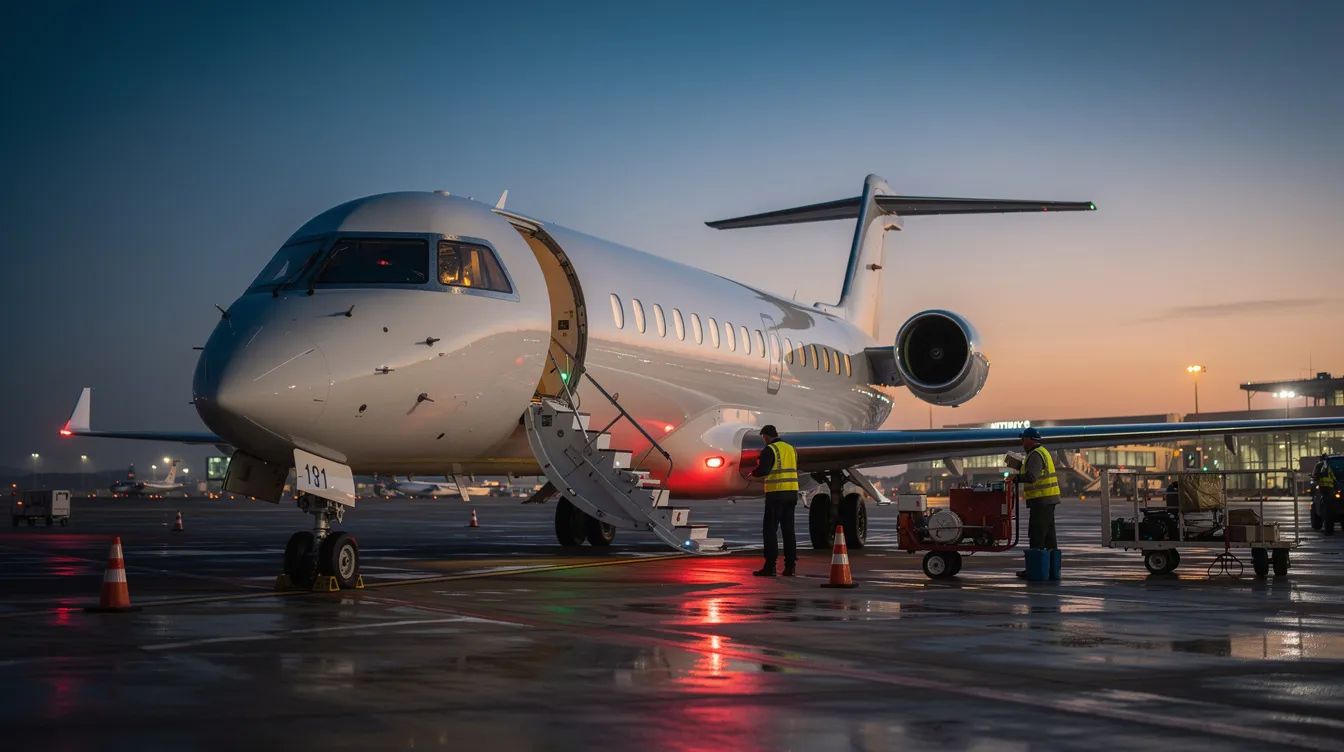
For executives, team owners, and high-net-worth travelers who need to move large groups with precision, the Embraer 175 represents a compelling intersection of capacity, efficiency, and cost. But what does an E175 actually cost—and when does it make strategic sense to access one? This guide breaks down every dimension of the Embraer 175 price, from acquisition and operations to charter rates and Jet Card alternatives, so you can make a decision grounded in real numbers.
Quick Answer: How Much Does an Embraer 175 Cost?
A used Embraer 175 typically costs around $25 million for a mid-life airframe in solid condition, though the broader market shows used E175s trading between $10 million and $25 million depending on age, total cycles, engine health, and cabin configuration. Older frames from 2005–2010 can dip below $10 million; newer builds with low cycles command a premium.
The Embraer E175 carries a list price of roughly $45 million to $60 million for a factory-new airplane. Embraer's last published catalog price for the E175 was $53.3 million in 2023. However, airlines negotiate steep volume discounts and often pay 30% to 50% less than list price, making the actual transaction cost for a new-build significantly lower than the sticker price.
The E175 is a regional jet—not a traditional business jet. Most private flyers who want to access this aircraft do so through charter operators or membership programs like BlackJet's Jet Card, not through direct ownership. Here's what access looks like across models:
Access or ownership option | Typical price | What to know |
|---|---|---|
Pre-owned purchase, airline-configured | $10 million–$25 million | Varies by year, maintenance status, cycles, and avionics |
Factory-new list price | $45 million–$60 million | Before fleet discounts; 2023 catalog price was $53.3 million |
Hourly charter | Approximately $9,500–$14,000 per flight hour | Crew and base fees are generally included; repositioning and minimums may add cost |
Jet Card access | Varies by program and aircraft category | Prepaid hours offer access to suitable aircraft without ownership |
BlackJet helps clients avoid the complexity of ownership entirely—no maintenance reserves, no depreciation risk, no crew payroll—while still delivering the cabin experience and capacity a mission requires through its premium private jet card programs.
What Is the Embraer 175? Regional Jet Basics for Private Flyers
The Embraer 175 is a twin-engine turbofan regional jet within Embraer's E-Jets family, first entering service in the mid-2000s. It was designed for short- to medium-range operations, connecting smaller cities to major aviation hubs effectively while offering a passenger capacity of 76 to 88 seats depending on configuration.
The E175 is the regional jet workhorse of North American aviation. It holds an 80% share of the US regional market, operated by commercial airlines on thousands of daily regional routes. That scale of service means parts availability, operator expertise, and reliability data are exceptional—qualities that translate directly to charter and private mission confidence. The aircraft is favored for regional routes due to its balance of capacity and performance.
Key specs for private flyers considering this aircraft:
Passenger capacity: 76 (dual-class) to 88 (high-density single-class)
Maximum cruise speed: Mach 0.82 (~541 mph)
Range: approximately 2,150 to 2,200 nautical miles
Service ceiling: 41,000 feet (maximum altitude)
Engines: powered by two GE CF34-8E turbofan engines
Some E175s are converted into corporate or VIP shuttle layouts, reducing seats to 30–40 and adding lounge, conference, or premium dining areas. These conversions bridge the gap between a standard airline plane and much larger aircraft like the Embraer Lineage or Dassault Falcon family, offering stand-up cabins with room for meaningful in-flight productivity.
New vs Pre-Owned Embraer 175 Pricing (2024–2027 Market Snapshot)
Embraer has not actively promoted the E175 as a "greenfield" private aircraft in recent years. Most new E175 deliveries flow to airlines or lessors under fleet deals. The anticipated E175-E2 production has been deferred, with deliveries now expected in the 2027–2028 timeframe. For buyers in the private and corporate shuttle market, the inventory is overwhelmingly pre-owned and airline-configured, then converted or operated under charter.
Pricing by segment:
E175 market segment | Indicative price | Typical considerations |
|---|---|---|
New-build list price (2023–2026 indicative) | $45 million–$60 million | Actual fleet transactions may be 30%–50% below list; order volume and fleet discounts can dramatically lower purchase costs |
Pre-owned, 2005–2010 builds | Approximately $8 million–$15 million | Older frames may have high cycles or upcoming heavy checks |
Pre-owned, 2011–2016 builds | Roughly $18 million–$25 million | Mid-life frames with modern avionics can command the upper band |
Pre-owned, 2017+ builds | $28 million–$40 million where available | Low-cycle airframes are rare on the open market |
Cabin configuration can affect the commercial value of the E175—airline-standard interiors sell differently than corporate shuttle or VIP conversions, which carry a premium for the finished interior but appeal to a narrower pool of buyers.
Corporate shuttle operators and ultra-high-net-worth families sometimes negotiate fleet deals or partnership arrangements for dedicated aircraft. For most high-frequency travelers, however, a BlackJet Jet Card or dedicated 25+ Hour Jet Card solution delivers a similar cabin experience on select larger aircraft types without any capital outlay.
Prices remain volatile. Airline fleet renewals, E175-E2 deferrals, and shifting demand for regional jets across the country all influence the market. Consult current broker listings for exact quotes before committing money to a purchase.
Key Cost Drivers: Why Two E175s the Same Year Don't Cost the Same
Asking price is just the starting line. Aircraft history and specification can swing the real Embraer 175 price by millions, even between two jets rolled off the production line in the same month. Maintenance history and aircraft age are important factors in determining resale value.
Major drivers:
Airframe hours and cycles: Regional jets accumulate high cycles relative to block hours due to frequent short-sector flying. Two same-year E175s might differ by thousands of cycles, directly affecting structural fatigue life and landing gear limits.
Maintenance status: Proximity to a D-check, landing gear overhaul, or APU replacement pulls value down sharply. Buyers factor in the cost of imminent heavy maintenance, which can run into several million dollars.
Engine program enrollment: The condition of GE CF34-8E engines significantly affects pre-owned aircraft pricing. Aircraft enrolled in manufacturer or "power-by-hour" engine programs can command premiums of $200,000 or more, because future maintenance cost is predictable and thrust performance is guaranteed.
Avionics suite: Older Honeywell Primus Epic installations versus upgraded cockpits with LPV approaches, ADS-B Out, and performance-based navigation create a meaningful value gap.
Cabin configuration: An airline 76-seat layout, a 30–40-seat corporate shuttle, or a full VIP conversion each serve a different segment of buyers. A complete VIP interior—private suites, lounge, conference area—can add $5 million to $15 million to the capital cost and fundamentally changes how the aircraft is used.
BlackJet clients sidestep these capital and refurbishment swings entirely. At booking time, you simply select the aircraft type and cabin category that fits your mission, and the fleet network handles the rest.
Operating Costs: Embraer 175 vs Large Business Jets
Acquisition price is only a fraction of lifetime cost. For an owner-operator, running a regional jet like the E175 can consume multiple millions annually. Annual operating costs for business jets range from 10% to 15% of the aircraft's value—and the E175 is no exception, even when compared to owning a $5 million private jet on the light or midsize end of the market.
Key annual cost categories:
Fuel consumption: The E175 burns approximately 650 liters per hour in cruise. Fuel cost per hour runs into several thousand dollars, comparable to a large business jet like a Dassault Falcon 900 or Embraer Legacy 600, though spread across far more seats.
Flight crew: Multi-pilot operations are required. Add cabin crew for charter or higher passenger counts, plus overnight allowances, training recurrency, and benefits.
Maintenance: Scheduled checks (C-checks, landing gear overhauls), engine LLP replacement at roughly $160–$200 per flight cycle, and unscheduled items. Engine performance restoration alone can cost over $1 million per engine.
Fixed costs: Insurance, hangarage, avionics updates, regulatory compliance, and training can total approximately $545,000 per year before the aircraft flies a single hour—a stark contrast to the economics of entry-level affordable private jets.
Fully burdened cost per hour: One ownership model estimates roughly $6,893 per flight hour at typical utilization, with total annual operating cost near $1.75 million.
Comparison to a large-cabin business jet: A converted Embraer Lineage or similar larger aircraft may show comparable direct operating cost per hour, but the E175's cost per seat is far lower when flying 40–80 passengers. The E175 is optimized for high utilization and scheduled service, not occasional private flights, which is why understanding jet card cost per flight hour is so important when comparing alternatives.
BlackJet's Jet Card model lets you rent the capability without owning the cost structure—especially valuable for clients who need high-passenger-capacity travel only a few times per year. Our broader guide to jet card cost and value can help you benchmark pricing against traditional charter.
Charter and Jet Card Pricing: Accessing an Embraer 175 Without Owning It
Most private clients encounter the E175 through charter, corporate shuttles, or Jet Card programs that can source large regional jets for specific missions. For the first time, many corporate travel managers discover that accessing a 76-seat jet doesn't require a purchase—it requires the right operator network.
Access model | Cost structure | Best suited to |
|---|---|---|
On-demand E175 charter | Approximately $9,500–$14,000 per flight hour; repositioning and minimums may apply | One-off group trips where the aircraft and schedule fit |
Per-seat shuttle | Fare per traveler on a scheduled private route | Groups seeking to share the aircraft cost |
Jet Card | Prepaid hours at program rates, with aircraft availability subject to program terms | Frequent travelers seeking predictable access across cabin categories |
Aircraft ownership | Purchase price plus crew, maintenance, fuel, insurance, and hangar costs | Airlines or organizations with consistent, high-volume utilization |
Hourly charter rates: $9,500–$14,000 per hour for an E175 or comparable regional jet, including crew and base fees. VIP-configured variants can push above $10,500 per hour.
Per-seat shuttle pricing: Corporate shuttle operators sell individual seats on scheduled private routes, dramatically lowering per-traveler cost compared to chartering an entire aircraft, similar in concept to many buy-a-seat private jet options.
Repositioning and minimums: Regional jets often carry daily minimum flight hour charges, plus repositioning fees if the aircraft isn't based at your origin airport. These add-ons can inflate total trip cost beyond the base hourly rate.
BlackJet structures its Jet Card with prepaid hours, transparent hourly pricing by cabin category, 24/7 digital booking, and the ability to request higher passenger-capacity aircraft when the mission calls for it. There's no inventory risk, no maintenance surprise, and no crew management on your board.
Ideal use cases: sports teams moving between destinations on tight schedules, roadshow tours spanning multiple cities, and high-end incentive travel where per-seat cost on an E175 beats buying dozens of commercial first-class tickets—closely mirroring the dynamics explored in our guide to charter plane costs for 100 passengers.
Cabin Experience and Passenger Capacity: How the E175 Feels Onboard
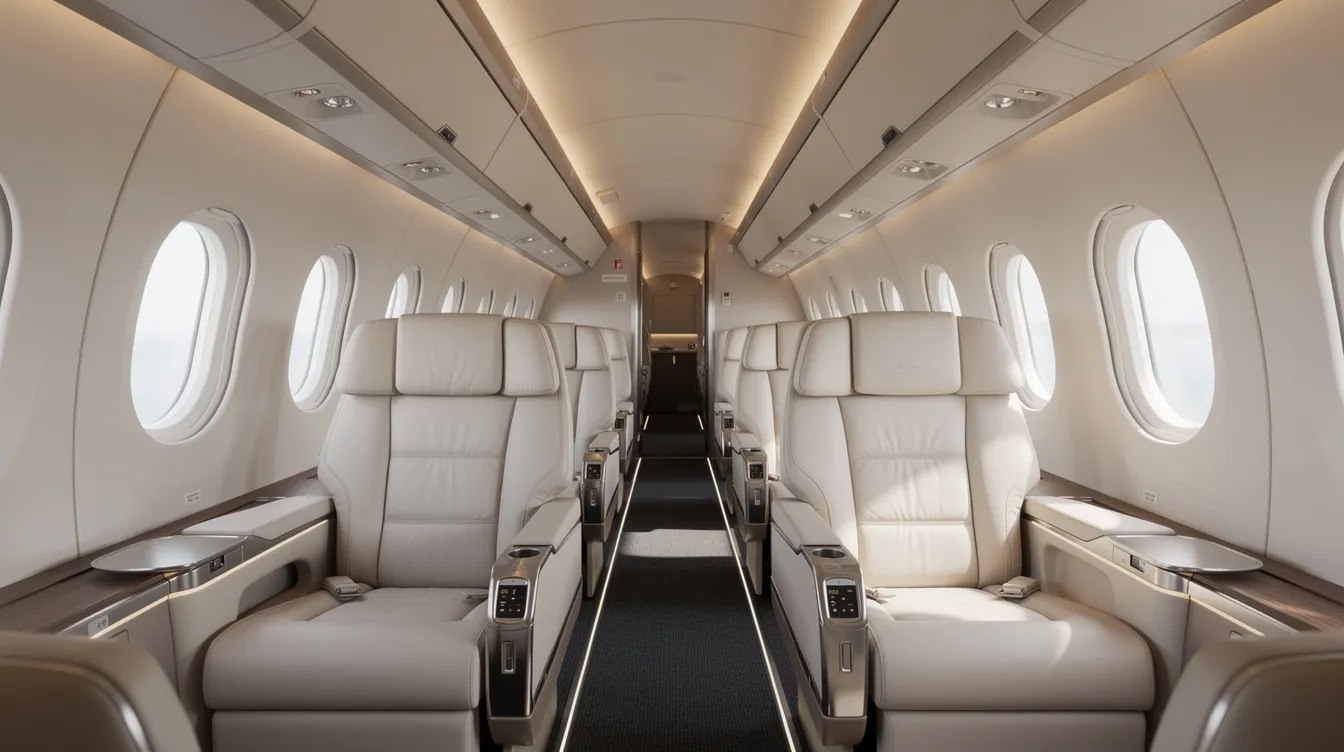
The E175's cabin is designed for passenger comfort in a way that sets it apart from many turboprops and older regional jets. The two-by-two seating arrangement eliminates middle seats entirely, giving every passenger either an aisle or a window. The stand-up cabin height of approximately 6.6 feet adds room that smaller regional aircraft simply cannot match.
Standard airline configuration: 76 seats in dual-class or 88 seats in single-class high-density layout. Airlines can customize seat pitch and service classes to match route demand.
Corporate shuttle layout: 30–40 business-class-style seats with fold-out tables, additional legroom, and premium finishes. This configuration shifts the E175 from a "regional jet" feel closer to what you'd experience on an Embraer Legacy or Lineage.
VIP conversion: As few as 15–25 passengers in lounge-style layouts with conference zones, enhanced galley service, Wi-Fi, and in-flight entertainment systems.
Amenities: Options include onboard Wi-Fi, IFE screens, full galley with catering service, and separate work and lounge zones in executive configurations.
An E175 makes financial sense over a large-cabin business jet when you're flying more than 20–30 passengers on sub-2,000 nm missions, though there are also large private jet options for 20 passengers that may be a better fit on certain routes. Below that threshold, a super-midsize or large jet typically delivers better per-person comfort and speed. BlackJet advisors help clients match party size and passenger capacity to the appropriate aircraft class, optimizing both price and onboard experience.
Embraer 175 vs Traditional Business Jets (Legacy, Praetor, Phenom, Falcon)
The E175 occupies a fundamentally different sweet spot in aviation than purpose-built business jets. Where the Embraer Phenom, Embraer Praetor, Embraer Legacy, Embraer Lineage, and Dassault Falcon families are designed to serve small parties with long range and bespoke luxury, the E175 is built to accommodate large groups efficiently over regional distances.
Feature | Embraer E175 | Traditional business jet |
|---|---|---|
Typical passenger capacity | 76–88 airline seats; fewer in corporate or VIP layouts | Often 6–16 passengers, depending on aircraft |
Range | Approximately 2,150–2,200 nautical miles | Varies widely; some large-cabin models exceed 6,000 nautical miles |
Cabin purpose | High-capacity regional transport | Privacy, bespoke interiors, and longer-range travel |
Best fit | Large groups on short- to medium-range routes | Smaller parties, longer missions, or premium cabin requirements |
Range: The E175 offers a range of approximately 2,150 to 2,200 nautical miles. The Embraer Praetor 600 reaches 3,900 nm. The Dassault Falcon 8X exceeds 6,450 nm. For intercontinental missions, business jets are the clear choice.
Cabin style: Business jets feature divans, private suites, conference tables, and, on ultra-long-range models, showers and bedrooms. The E175 cabin, even in VIP conversion, retains an airline-derived architecture.
Passenger counts: Most business jets carry 6–16 passengers. The E175 can seat up to 88 passengers in high-density configuration. Cost per seat on charter drops dramatically with larger groups aboard the E175.
When should a BlackJet client choose a business jet instead? For intercontinental missions, parties under 15, or when privacy and luxury detailing are paramount—a Praetor, Legacy, or Falcon delivers an experience a regional jet cannot replicate. BlackJet's fleet access spans light jets (similar to Phenom), midsize and super-midsize (Praetor/Legacy segment), and large jets, giving members flexibility far beyond a single aircraft type.
Sample Mission Scenarios: When Does an Embraer 175 Make Financial Sense?
The right aircraft is always defined by mission profile, not by brochure specs.
Corporate roadshow: A company needs to move 40 executives from New York to Chicago to Dallas over three days. Flying commercial means coordination nightmares across multiple airlines and airports. Chartering a single E175-class regional jet through BlackJet consolidates the group, allows flexible departure times, and keeps per-seat cost competitive with business-class commercial tickets while saving hours of ground time at each destination.
Sports or entertainment tour: A US-based team of 55 players and staff moves between mid-market cities on a weekly schedule. Using three midsize business jets would cost more in aggregate and create logistical friction. A single E175 shuttle operated by a certified Part 121 operator keeps the group together, reduces money spent on duplicate crew and repositioning, and maintains schedule control, though some groups may instead prefer private jet charter options for 50 passengers.
Luxury incentive trip: A company rewards 60 top clients with a Mediterranean getaway, flying from a European hub to a resort destination. Per-seat charter on an E175 beats purchasing 60 first-class commercial tickets, avoids airline schedule constraints, and delivers a branded, private experience from wheels-up.
BlackJet uses route data, passenger count, and scheduling constraints to recommend the most efficient aircraft category for Jet Card members—whether that's a regional jet, a super-midsize cabin, or something in between, always grounded in transparent Jet Card pricing structures.

Safety, Certification, and Sustainability for E175 Operations
Regional jets like the Embraer 175 operate under the same stringent airline-level safety standards as mainline fleets flown by Boeing and other manufacturers. The E175's safety record in commercial service is strong, with the type logging millions of flight hours across dozens of operators worldwide.
Certification and maintenance: E-Jets in airline and charter service follow rigorous scheduled maintenance regimes—C-checks, D-checks, engine overhauls, and compliance with all airworthiness directives.
Operator vetting: BlackJet partners only with operators meeting top-tier safety audits (ARGUS Platinum, Wyvern Wingman, IS-BAO) and proprietary vetting standards that go beyond minimum regulatory requirements.
Emissions and noise: The GE CF34-8E turbofan engines are more efficient and quieter than older-generation regional jet powerplants. Advanced operating procedures such as continuous descent arrivals further reduce noise and fuel burn.
BlackJet's carbon-neutral commitment applies to every flight—whether on a light jet, midsize aircraft, or a regional jet like the E175. Every mission is offset to net-zero using verified carbon projects, at no extra cost or effort from the member. Real-time tracking, digital flight briefs, and health monitoring technology further enhance operational reliability for clients using regional jets through BlackJet.
Alternatives to Buying an Embraer 175: Jet Cards, Charter, and Fractional Ownership
Outright ownership of a regional jet is usually only rational for airlines or very large corporations with constant high-density travel needs, whereas many private flyers are better served by lower-cost private aircraft and access models. For most private flyers, the capital burden and operational complexity of an E175 far exceed what the mission profile justifies.
Direct ownership: Large capital outlay ($10M–$40M+), complex crew and maintenance infrastructure, and exposure to residual value risk on a niche regional jet. You'll need dedicated hangar space, a maintenance management company, and a crew pipeline—compared to the far leaner profile of owning a smaller, cheaper plane.
Fractional ownership: More common for business jets than regional jets. Fractional programs offer shared usage but still carry annual management fees, hourly occupied rates, and limited scheduling flexibility, similar to how many budget-friendly small plane ownership structures trade capital savings for operational constraints.
On-demand charter: Maximum flexibility, no capital commitment. But pricing varies by season, peak-day availability can be tight, and repositioning fees inflate costs unpredictably—issues that many travelers solve by locking in a 50-hour jet card program instead.
Jet Cards (BlackJet): Prepaid hours at transparent rates, guaranteed access across business jet cabin classes, and the ability to upsize to higher passenger-capacity aircraft—including regional jets—when the mission demands it, making them one of the best jet card options for frequent flyers.
A Jet Card represents the strategic middle ground: elite access and predictability without the balance-sheet impact of owning an Embraer 175. Think in terms of annual flight hours, route profile, and group size rather than fixating on one specific airframe type.
FAQ: Embraer 175 Price, Performance, and Private Use
Is the Embraer 175 a business jet or a regional jet?
The E175 is fundamentally a regional jet, designed to serve airline networks with high-frequency, short- to medium-range flights. Some are converted into VIP or corporate shuttle layouts, but its origins, certification, and primary market align it with regional airliners, not bespoke business jets.
What is the average price of a used Embraer 175 in 2026–2027?
Used E175s typically trade between $10 million and $25 million depending on condition, production year, engine status, and cabin layout. Early-2000s builds with high cycles may fall below $10 million; newer, low-cycle frames can exceed $25 million.
How does the E175's range compare to larger business jets?
The E175 offers a range of 2,150 to 2,200 nautical miles—solid for domestic and regional missions. Larger business jets like the Embraer Praetor 600 reach 3,900 nm, while ultra-long-range jets from the Dassault Falcon or Gulfstream families can fly 6,000–7,000+ nm nonstop.
Can I charter an Embraer 175 for private use?
Yes. Specialized operators offer E175 charter through dedicated charter brokers and programs like BlackJet's fleet network. Hourly rates typically run $9,500–$14,000, with VIP-configured variants costing more.
What's the difference between an Embraer Legacy, Lineage, and an E175?
The Embraer Legacy and Embraer Lineage are dedicated business jet families—some derived from regional jet platforms—with bespoke interiors, fewer seats, and higher luxury standards. The E175 is an airline-focused platform optimized for capacity and efficient regional operations. Think of it this way: Legacy and Lineage sell privacy and finish; the E175 sells scale and speed for groups.
When would BlackJet recommend a regional jet instead of multiple business jets?
For large groups of 20–80+ passengers on short- to medium-range legs—corporate roadshows, team travel, event shuttles—a single regional jet typically costs less, simplifies logistics, and keeps everyone together compared to chartering three or four smaller jets.
For a tailored cost comparison between chartering an E175-type regional jet and accessing business jets through a Jet Card, speak with a BlackJet aviation advisor or review our breakdown of 100-hour jet card program costs.
How BlackJet Helps You Navigate Embraer 175 Pricing and Alternatives
Understanding the true Embraer 175 price means looking beyond the sticker and into mission economics—acquisition, annual operating cost, opportunity cost, and how the aircraft compares to alternatives you can access without ownership. That's where BlackJet's approach delivers clarity.
Mission profiling: We analyze your typical routes, passenger counts, and time sensitivity to determine whether a regional jet, large-cabin business jet, or midsize aircraft is the most efficient fit, much like the assessment process described in our Flexjet jet card cost guide.
Aircraft matching: Recommendations are based on hard numbers—not hype. Light, midsize, super-midsize, large cabin, or regional jet: the right class depends on the mission at hand, whether you're moving a small executive team or planning a 100-passenger private charter.
Transparent, carbon-neutral Jet Card pricing: Complex cost structures collapse into a simple hourly rate, with every flight offset to net-zero, making it easy to compare against NetJets jet card pricing models and other providers.
24/7 digital booking and real-time support: Adjust aircraft size on short notice—upsizing to a regional jet for a special event, or scaling down to a midsize cabin for a smaller party.
Explore BlackJet's Jet Card programs or schedule a consultation to compare the economics of owning an Embraer 175 versus leveraging premium private jet access. The smartest aviation decision isn't always about which aircraft to buy—it's knowing when not to.