The G700 leap: How Jeff Bezos is redefining speed for the modern billionaire
June 23, 2026
Ultra-high-net-worth individuals and corporate leaders are adopting ultra-long-range jets like the Gulfstream G700 to collapse geographic distance and reclaim productive hours in global operations. Jeff Bezos' acquisition of a G700 via Poplar Glen LLC exemplifies this strategic shift, treating aircraft not as luxury but as operational necessity.
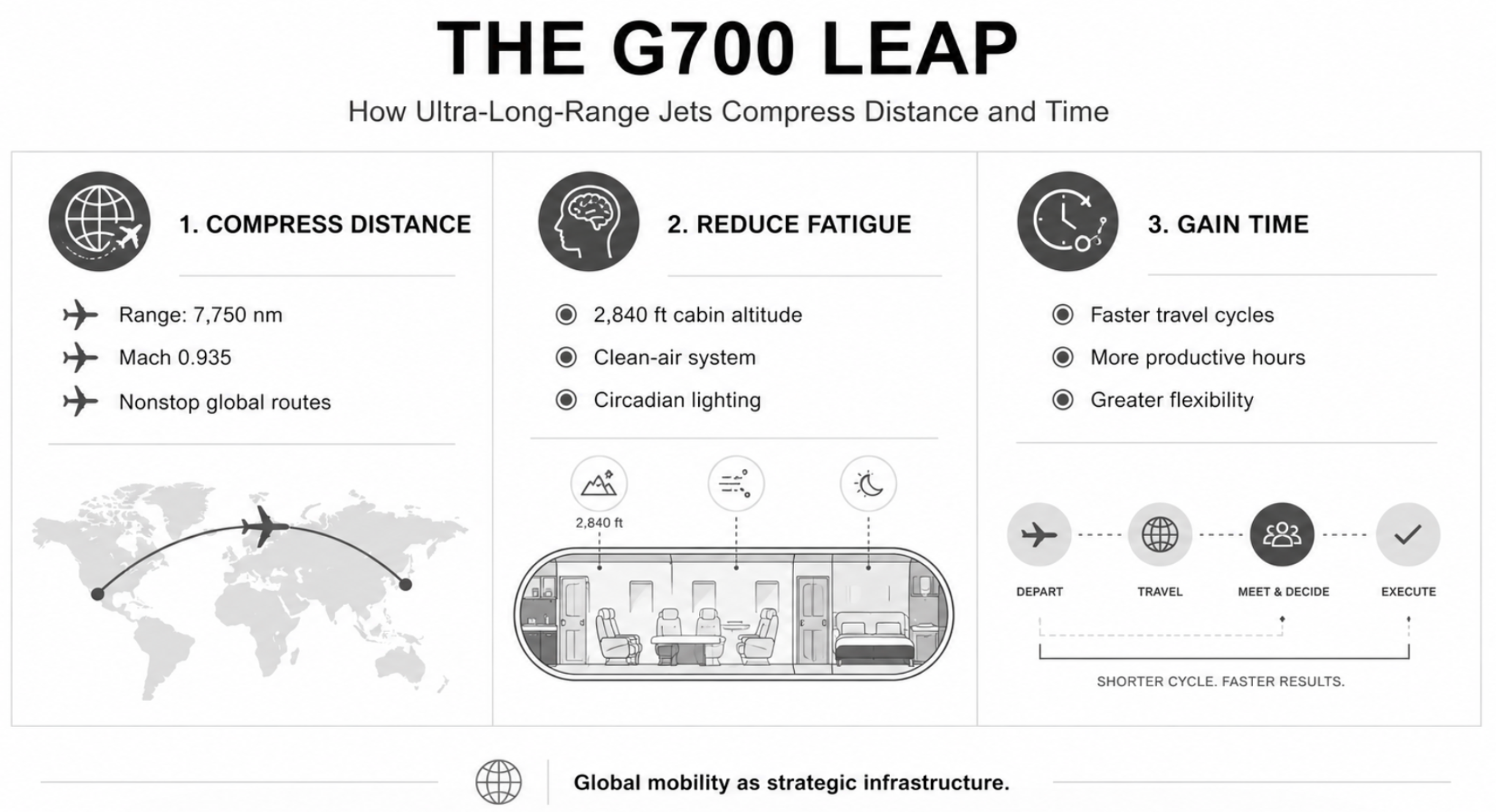
BlackJet, a private jet card program operator, outlined the benefits of utilizing ultra-long-range jets to compress travel distance, reduce fatigue, and gain back time.
Compressing Distance, Reclaiming Productivity
The financial justification for acquiring business tools of this magnitude rests entirely on operational efficiency. Modern enterprise requires rapid intercontinental presence, and traditional transoceanic flight profiles enforce an artificial ceiling on executive output.
Time zone fragmentation across global operations creates scheduling inefficiencies that compress executive productivity. Advancing propulsion engineering means corporate flight departments can directly reclaim lost productive hours. The platform utilizes twin Rolls-Royce Pearl 700 engines, each generating 18,250 pounds of thrust, driving the airframe to a maximum operating speed of Mach 0.935, while achieving a 12% improvement on thrust-to-weight ratio compared with last-gen equivalents, and 5% better fuel efficiency.
This capability compresses a standard 12-hour intercontinental flight profile by nearly an hour compared to legacy platforms. A management team overseeing diverse global holdings in any organization stands to benefit from that compression, as it unlocks dozens of salvaged operating hours every quarter. Capital allocation decisions can occur in real time on the ground rather than be deferred by terminal airspace congestion.
The practical advantage becomes clear in real-world deployments across Asia, Europe, and North America. Standard intercontinental commercial travel structurally degrades executive output through transit delays and time-zone fragmentation.
However, an analysis of corporate aviation published in the Journal of Air Transport Management found that the strategic utilization of private aircraft directly mitigates travel-induced fatigue and emotional exhaustion. By eliminating the multiday recovery buffers traditionally required for global portfolio reviews, organizations collapse travel cycles and reclaim those days for headquarters-based strategic work.
Similarly, time-sensitive capital deployment decisions—opportunities that require in-person due diligence and board approval within days rather than weeks—become executable. Executives can conduct site assessments in London, return to New York for investor meetings, and authorize deployment the same week.
This compression transforms private aviation from administrative convenience into a competitive accelerant, enabling organizations to move faster than competitors constrained by commercial flight schedules.
How Cabin Design Preserves Executive Performance
Compressing flight duration yields minimal economic advantage if the executive arrives too fatigued to negotiate complex deals. Extended exposure to low-pressure environments, dry recycled oxygen, and erratic time shifts degrades cognitive performance and compounds physical fatigue.
The corporate layout of Bezos' platform addresses this biological wear through advanced interior environmental controls. The cabin design optimizes physical recovery, implementing features that support rapid physiological adaptation.
The cabin achieves a record-low altitude of 2,840 feet while cruising at 41,000 feet, drastically mitigating physical strain. A plasma ionization system continuously neutralizes pathogens and freshens interior oxygen. A specialized circadian lighting matrix simulates precise regional dawns and dusks to systematically neutralize jet lag.
These environmental factors operate within a cabin measuring 56 feet and 11 inches in length, configured into five discrete living zones. The layout provides a complete forward ultragalley, a conference space, and an isolated rear stateroom featuring a queen-length bed and an en-suite private shower. This complete compartmentalization allows executives to step directly from a 7,750-nautical-mile international leg straight into high-stakes negotiations without requiring a standard hotel recovery buffer.
Why Ultra-Long-Range Jets Become Strategic Assets
The shift toward ultra-long-range assets reflects a permanent evolution in corporate asset utilization strategy. Enterprise operations are no longer confined by regional boundaries, demanding an infrastructure that can support immediate, flexible, and nonstop international deployment.
Organizations that treat travel purely as an administrative overhead expense inevitably fall behind competitors that view global mobility as a force multiplier. This modern approach to aviation highlights that the ultimate luxury for a billionaire is not material ostentation.
True luxury is the systemic conquest of geographic distance and human fatigue.


 Sign up with google
 Sign up with Apple